Forureningsprofil på Arsenalvej 6 peger på historisk industribrug
Sammenligning af jordprøve-resultater (DJ MILJØ, juni 2024) med DKjords kortlægning af den tidligere sprængstofsfabrik og skibsværft på Parcel AR3A
Jordprøverne fra 18. juni 2024 viser en forureningsprofil (kviksølv, bly, kobber, zink, PAH, oxiderede kulbrinter) som præcist matcher de industrier, der historisk har ligget på matriklen — sprængstofsfabrik og skibsværft — og som præcist svarer til de 6 komponenter, DKjord allerede har kortlagt på lokalitet 101-00410. Kulbrinterne er ifølge lab-rapporten "asfalt/bitumen/smøre-/hydraulikolie" — en gammel, oxideret signatur, ikke frisk jord.
Foreningens egen jord-tilførsel fra 2015 og frem er dokumenteret klasse 0/1 ren jord fra RGS 90 og blev eksplicit skriftligt godkendt af TMF 21-10-2015 (Pia Thomsen, Jord og affald): "der kræves ikke en form for tilladelse omkring jorden til dette projekt". Forvaltningens efterfølgende påstand (14-03-2025) om at foreningen har "påkørt store mængder jord uden tilladelser" er i direkte modstrid med denne mail.
Forvaltningen behandlede ikke desto mindre foreningen som forurener og iværksatte indhegning og lovliggørelsesforløb uden først at afklare kilden. Supplerende kildesporings-analyser (TBT, nitroaromater, Pb-isotoper, PAH-fingeraftryk) blev aldrig udført, selvom de ville have afgjort ansvarsspørgsmålet endegyldigt.
1. Grundlag — hvad blev fundet og hvad siger historien
DJ MILJØ & GEOTEKNIK udtog 18. juni 2024 10 jordprøver fra 3 miler (mile 1, 2, 3) på pladsen i dybder M1–M4. Analyserapport 2425048 fra Højvang Laboratorier viser den stærkeste forurening i mile 3 (M2 og M3). DKjord-kortlægningen af lokalitet 101-00410 lister uafhængigt præcis de samme komponenter som forureningskilder knyttet til den tidligere industri.
| Stof | Fund (Mile 3) | Sprængstofsfabrik | Skibsværft |
|---|---|---|---|
| Kviksølv | 1,2 mg/kg | Kviksølvfulminat — klassisk detonator/tændsats i ammunition | — |
| Bly | 490 mg/kg | Blyazid, blystyphnat (tændsatser) | Blymønje, bundmaling, kølsvin |
| Kobber | 140 mg/kg | — | Antifouling-bundmaling, kabler, fittings |
| Zink | 450 mg/kg | — | Offer-anoder på skibsskrog, primere, maling |
| PAH (sum 7) | 2,1 mg/kg | Tjære/bitumen fra fyringsprocesser | Stenkulstjære, imprægnering, tjærede bundgarn |
| Kulbrinter | "asfalt/bitumen/smøre-/hydraulikolie" | — | Brændstof, hydraulikolier — gammel, oxideret |
| Cadmium | 1,2 mg/kg | Cd-primere | Galvanisering, maling |
| Asbest | Ikke påvist | — | — |
| PCB | Under detektion | — | — |
DKjords egen kortlægning af lokalitet 101-00410 (hentet 19-04-2024, attest udstedt 09-09-2024) lister som forureningskilder: dieselolie, kobber, kviksølv, zink, tungmetaller og bly. Dette er præcis de samme 6 komponenter som prøverne viser. Sammenfaldet er ikke tilfældigt — det er en bekræftelse af den allerede dokumenterede historiske kilde.
2. Hvorfor prøverne peger på historisk, ikke nyligt tilført forurening
- Kviksølv på 1,2 mg/kg er en specifik industri-signatur. Københavnsk baggrundsniveau er typisk <0,1 mg/kg. Kviksølv findes ikke i almindelig byggepladsjord eller havejord — kun i specifikke industrier (tændsatser/sprængstoffer, klor-alkali, termometer-fabrikker). Kviksølvfulminat-sporet passer entydigt til sprængstofsfabrikken, som tidligere var registreret på matriklen.
- Kulbrinterne er gammel, oxideret forurening. Lab-rapporten beskriver selv kulbrinterne som "svarende til asfalt/bitumen/smøre-/hydraulikolie" — en signatur af nedbrudt, aldret olie. Frisk motorolie eller diesel fra nyligt tilført byggepladsjord ser markant anderledes ud i GC-FID kromatogrammet. Signaturet tyder på årtiers nedbrydning, ikke nyligt oplag.
- Stofkombinationen er et klassisk skibsværft-fingeraftryk. Cu+Zn+Pb+Hg+PAH sammen er den typiske profil fra kystnær maritim industri: kobber fra antifouling-maling, zink fra offer-anoder, bly fra bundmaling og kølsvin, kviksølv fra tændsatser, PAH fra tjæreholdige produkter. At finde alle fem stoffer i samme prøve er en bekræftelse af, at kilden er integreret industriaktivitet — ikke tilfældigt tilført jord.
- Fordelingen af forureningen er ujævn. Mile 1 og 2 viste lave værdier, mens mile 3 var stærkt forurenet. Hvis foreningen havde tilført ensartet forurenet jord til hele anlægget, ville man forvente ensartet forurening. Det observerede mønster (enkelte hotspots) ligner lokaliserede historiske forureningsreder fra industriens tid, ikke ensartet tilførsel.
3. Hvad kommunen kunne have testet — men ikke gjorde
Hvis kommunen ville afklare kilden endegyldigt, kunne rådgiveren være bedt om at udtage supplerende prøver med kildesporings-analyser. Disse tests er velkendte standardmetoder i jordforurenings-sager, hvor ansvaret skal fordeles mellem flere mulige kilder. Ingen af dem er blevet udført på Arsenalvej 6:
| Test | Hvad det kan afgøre |
|---|---|
| TBT (tributyltin) | Antifouling-maling brugt 1970-2008 — entydig skibsværft-signatur fra den periode. Fund bekræfter maritim industri; fravær svækker ikke historik-hypotesen (da TBT kun dækker en del af værftets driftsperiode) |
| Nitroaromater (TNT, DNT, RDX m.fl.) | Sprængstofrester — entydig sprængstofsfabrik-signatur. Fund bekræfter historisk sprængstof-aktivitet som forureningskilde |
| Stabile Pb-isotoper (²⁰⁸Pb/²⁰⁶Pb, ²⁰⁷Pb/²⁰⁶Pb) | Kan skelne mellem historisk industribly (skibsmaling, tændsatser) og moderne trafik-/byggebly. Afgørende for at fastslå hvor den fundne bly kommer fra |
| PAH-fingeraftryk (fenantren/antracen-ratio mv.) | Skelner mellem pyrogen PAH (forbrænding, tjære = historisk) og petrogen PAH (olie = typisk nyere). Metodestandard i kildeallokering |
Disse supplerende analyser ville have lukket ansvarsspørgsmålet. De blev ikke udført — hvilket efterlader det indtryk, at forvaltningen besluttede foreningens ansvar uden først at afklare det faktuelle grundlag.
4. Foreningens jordtilførsel var dokumenteret ren — og eksplicit godkendt af TMF i 2015
KEJDs hovedargument for at igangsætte jordforureningsundersøgelsen i 2024 var, at der var "påkørt store mængder jord uden tilladelser fra KEJD eller KFF" (referat 14-03-2025). Dette er faktuelt forkert:
Dokumentation: TMF-mail 21. oktober 2015 kl. 11:18
Foreningen sendte 15-10-2015 kl. 11:58 en skriftlig forespørgsel til TMFKP BA CMB Miljøbeskyttelse (jordhaandtering@tmf.kk.dk) med fuld beskrivelse af projektet:
- Formål: 4 nye hop + vedligehold af eksisterende bane og pumptrack
- Jordklassifikation: klasse 0/1 (ren jord)
- Leverandør: RGS 90 A/S, Selinevej 4, 2300 København S
- Kvalitetssikring: "Jorden er modtaget på vores anlæg hvorefter den bliver analyseret (1 prøve pr 30 tons) og klassificeret som ren jord (kl 0/1). Efterfølgende er jorden sorteret for sten og brokker på et 80 mm sold."
Svaret kom 21-10-2015 kl. 11:18 fra Pia Thomsen, Cand.scient, Jord og affald, Teknik- og Miljøforvaltningen (pjatho@tmf.kk.dk, direkte 23 69 52 21):
"Kære Behroz Karimi
Vi har ingen bemærkninger til dette projekt.
Der kræves ikke en form for tilladelse omkring jorden til dette projekt."
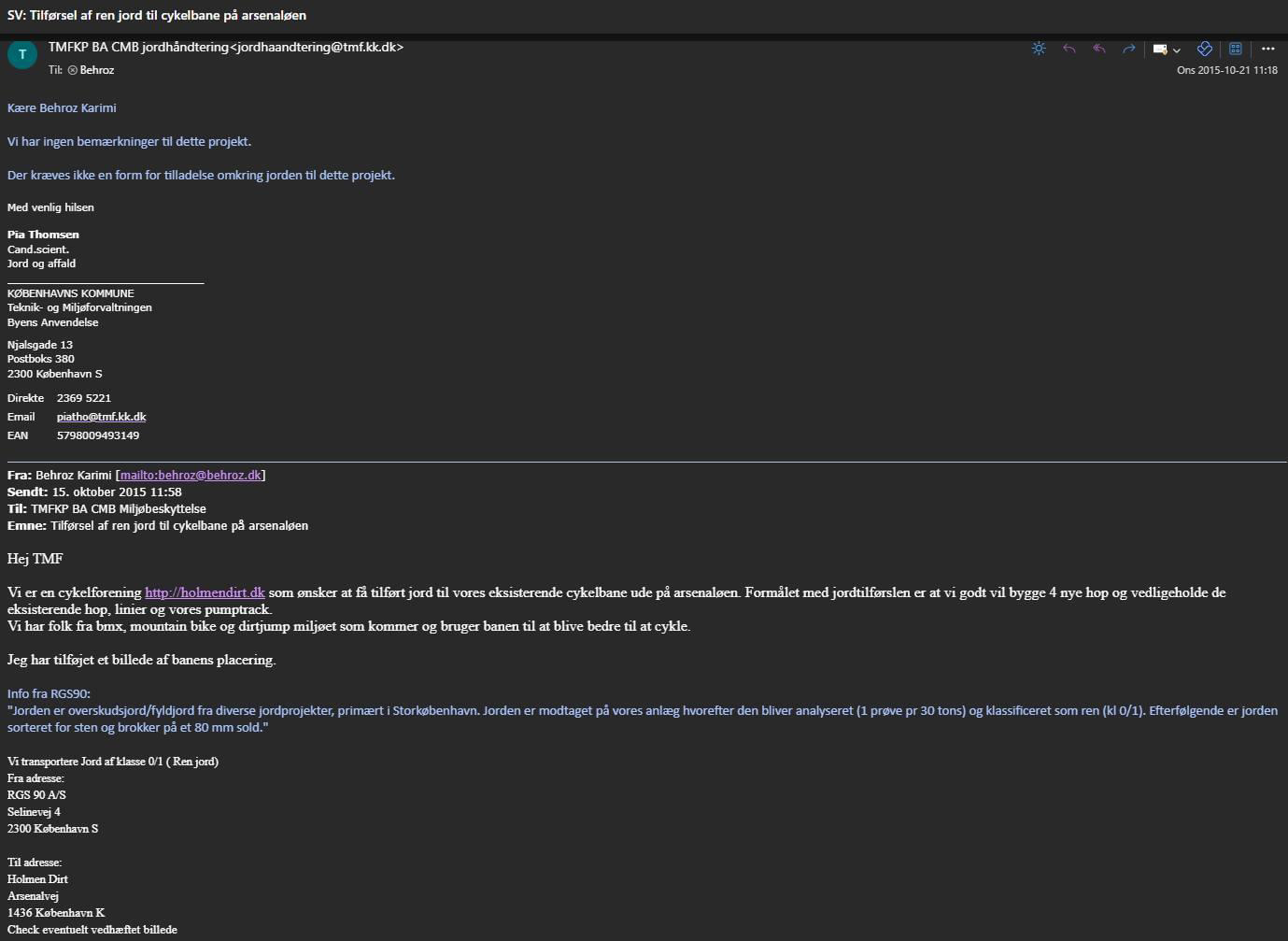
Denne 2015-mail er afgørende for ansvarsspørgsmålet:
- Afsenderen er TMF's egen faglige myndighed for jord og affald — ikke en tilfældig sagsbehandler i en anden afdeling
- Foreningens beskrivelse var fyldestgørende og teknisk præcis (leverandør, klasse, analyseregime)
- Ordlyden er utvetydig: "der kræves ikke en form for tilladelse"
- Foreningen har handlet i god tro og i overensstemmelse med TMF's egen vejledning i 10 år
RGS 90's vejelister for foreningens jordtilkørsler fra 2015 og frem kan leveres af RGS Nordic (Thomas Munksgaard, tmun@rgsnordic.com) og udgør supplerende dokumentation for at den tilførte jord gennem hele perioden har været klasse 0/1 ren jord.
5. Hvad TMF burde have vidst fra egne systemer
Ud over det tekniske spørgsmål (om hvad prøverne reelt viser) er der et selvstændigt forvaltningsretligt spørgsmål: burde TMF have kendt den relevante forhistorie, før forvaltningen i 2024 besluttede at iværksætte prøvetagning og indhegning med foreningen som forudsat ansvarlig?
Forvaltningsretligt grundlag
- Journaliseringspligt (offentlighedsloven § 15). Alle dokumenter, der ind- og udgår vedrørende en sag, skal journaliseres. 2015-mailtråden er en skriftlig forespørgsel om et konkret projekt og et skriftligt myndighedssvar med retsvirkning — den skal ligge i TMF's sagssystem og være fremfindbar via matrikel eller adresse.
- Enhedsforvaltnings-princippet. Københavns Kommune er forvaltningsretligt én juridisk person. TMF's afdeling for byggesager kan ikke påberåbe sig ikke at vide, hvad TMF's afdeling for jord og affald har svaret — særligt ikke inden for samme faglige myndighedsområde.
- Berettiget forventning. Når en myndighed skriftligt vurderer at "der kræves ikke en form for tilladelse", erhverver borgeren en berettiget forventning om at kunne fortsætte aktiviteten. Forvaltningen kan ikke uden videre — og uden først formelt at tilbagekalde tilsagnet og foretage partshøring efter forvaltningsloven § 19 — behandle samme aktivitet som uretmæssig.
- 2015-mailen var sendt til TMF's egen jordhåndterings-afdeling (
jordhaandtering@tmf.kk.dk) — ikke til en tilfældig mailadresse. Afsenderen Pia Thomsen sad i "Byens Anvendelse, Center for Miljøbeskyttelse, Jord og affald" — præcis det faglige område 2024-sagen faldt ind under.
To dokumenter i TMF/KK's egen viden der begge pegede væk fra foreningens ansvar
| Kilde i kommunens egen arkivviden | Hvad den fortæller |
|---|---|
| TMF-mail 21-10-2015 (afd. Jord og affald, Pia Thomsen) |
Den af foreningen tilførte jord er klasse 0/1 ren jord fra RGS 90, analyseret med 1 prøve pr. 30 tons, sigtet på 80 mm sold — og "der kræves ikke en form for tilladelse" |
| V2-kortlægning 14-12-2000 (Miljøkontrollen, j.nr. 000020-241551) |
Historisk industriforurening på arealet — "bly og kviksølv og i enkelte prøver zink" — dokumenteret 24 år før 2024-prøverne. Sendt direkte til Økonomiforvaltningen (KEJDs forgænger) |
Med disse to dokumenter i hånden er den faglige basisvurdering klar: prøvefundene i 2024 stammer sandsynligvis fra den historiske industri, ikke fra foreningens (dokumenteret rene, TMF-godkendte) tilførsel. Det præcis modsatte konklusion — at foreningen er forurener — kræver supplerende kildesporing (afsnit 3). Den blev ikke udført.
Manglende due diligence i 2024
Før iværksættelse af prøvetagning, indhegning og inddragelse af STPS/politikere burde administrationen som minimum have foretaget følgende grundlæggende skridt:
- Opslag i kommunens eget sagssystem for matrikel 616 → ville have vist byggetilladelsen 2014, TMF-mailen 2015, V2-kortlægningen 2000, klagenævnsafgørelsen 2022
- Kontakt til TMF's afdeling for jord og affald (der havde givet 2015-tilsagnet) for faglig vurdering
- Partshøring af foreningen efter forvaltningsloven § 19 inden beslutning om lukning
- Konkret spørgsmål til foreningen og RGS Nordic om hvilken jord der er tilført, hvornår og i hvilke mængder
Ingen af disse skridt er dokumenteret i det materiale, foreningen har fået aktindsigt i.
Prøverne tester ikke engang det, der blev tilført
Det skal bemærkes, at DJ MILJØs 10 prøver blev udtaget fra 3 jordmiler på pladsen. Der er ingen dokumentation for, at disse miler specifikt indeholder de af foreningen tilførte RGS 90-leverancer. Miler på en gammel værftsgrund kan lige så vel bestå af:
- Oprindelig topjord fra værftstiden (før 1998)
- Jord blotlagt ved senere terrænbearbejdning der har opgravet historisk forurenede lag
- Blanding af historisk jord og tilført ren jord
Uden kildesporings-analyser (TBT, Pb-isotoper mv.) kan kilderne ikke adskilles. Prøverne dokumenterer at der er forurening — de dokumenterer ikke hvem der er forurener.
6. Kommunens dokumenterede fejlslutning
Af referatet fra mødet 14. marts 2025 (KFF-sag 2025-0089428, sagsbeh. Kim Natour Svendsen) fremgår KEJDs redegørelse:
"KEJD fortæller, at man først ifm. at man fik viden om at der er påkørt store mængder jord uden tilladelser fra KEJD eller KFF er blevet bekymret for jordens beskaffenhed og derfor valgt at tage jordprøver. Man har før det ikke haft grund til at tro at jorden skulle være mere forurenet end i byen generelt."
Denne redegørelse kan ikke opretholdes:
- Jord-tilførslen var ikke "uden tilladelser" — TMF havde 21-10-2015 eksplicit skriftligt meddelt at "der kræves ikke en form for tilladelse" (se afsnit 4)
- Matriklen var allerede V2-kortlagt i DKjord med præcis samme forureningskomponenter som senere blev fundet i prøverne — en offentligt tilgængelig landsdækkende database
- Den historiske anvendelse (sprængstofsfabrik, bygning og reparation af skibe og både) fremgår direkte af DKjords brancheliste for lokaliteten, med driftsperiode "frem til 31-12-1998"
- Politikersvar 20-01-2025 (F2-sag 2024-18059) bekræfter selv kommunens viden: "Arealet er kortlagt som forurenet på vidensniveau 2, hvilket betyder, at der er kendskab til forurening i området"
Kommunen kendte til den historiske forurening og havde selv godkendt foreningens jord-tilførsel, men valgte at behandle prøvefund som foreningens ansvar — uden først at afklare, om den fundne forurening stammede fra den (TMF-godkendte, klasse 0/1) tilførte jord eller fra den dokumenterede historiske industri.
7. Retlig konsekvens — § 8-ansvarsfordeling
Efter jordforureningsloven er det forureneren, der er ansvarlig for oprensning (princippet i § 41 mv.). Hvis forureningen overvejende er historisk — dvs. stammer fra den industrielle anvendelse frem til nedlæggelsen i 1998 — ligger ansvaret hos den tidligere driftsherre eller i sidste instans hos grundejeren (Københavns Kommune). Ikke hos foreningen.
Dette har direkte betydning for:
- § 8-ansøgningens indhold — hvor RKE Consult bør inkludere en eksplicit kildevurdering, så ansvarsfordelingen bliver dokumenteret som del af tilladelsen
- KFBU-indstillingen — hvor scenarie A og B's omkostningsfordeling bygger på en antagelse om, at foreningen bærer ansvaret for jorden. Hvis ansvaret reelt ligger hos grundejeren, ændrer det forudsætningerne for begge scenarier
- Forlængelse af brugsaftale og ejerfuldmagt — hvor spørgsmålet om foreningens "misligholdelse" ikke kan afgøres, før kilden er afklaret
8. Anbefaling
Foreningen anbefaler, at:
- Der snarest indhentes en uafhængig miljøfaglig udtalelse fra en akkrediteret geokemiker / jordmiljørådgiver (fx Niras, Cowi, Orbicon, DMR Miljø), som vurderer om den fundne forurening overvejende kan tilskrives den historiske industri eller den af foreningen tilførte jord
- § 8-ansøgningen (RKE Consult) eksplicit inkluderer kildesporings-analyser (TBT, nitroaromater, Pb-isotoper, PAH-fingeraftryk) på de 4 kvadranter, så ansvarsspørgsmålet afgøres endegyldigt
- KFBU-indstillingen suppleres med en orientering om at ansvarsspørgsmålet ikke er afklaret, og at scenariernes omkostningsfordeling derfor står på et ufuldstændigt grundlag
- Indtil kilden er afklaret, behandles foreningen ikke som forurener, men som bruger af et V2-kortlagt areal, hvor grundejer har ansvar for den historiske forurening
Ansvarsforbehold. Denne analyse bygger på lab-rapportens data (DJ MILJØ sag 241742, rapport 2425048), DKjords offentlige kortlægning af lokalitet 101-00410 og almindelig industrihistorie for Arsenaløen. Analysen er udarbejdet af foreningen selv og erstatter ikke en formel udtalelse fra en akkrediteret miljørådgiver. Til brug i myndighedssammenhæng anbefales det, at konklusionerne verificeres af en geokemiker eller jordmiljørådgiver med relevant akkreditering. Foreningen arbejder på at indhente denne udtalelse.